So sorry I haven't written in a while... Sam got here last Monday and I've been pretty busy ever since, so here's what I remember. I spent one more peaceful night on the island, enjoying the sunset and chatting up the locals. On the morning that I left the island I caught the noon ferry headed towards Canakale and met a Turkish guy named Ersin on the boat.
  He helped me to beat the crowd getting off the boat and onto the scarce bus seats and so on the next ferry ride 30 minutes later across the Bosporus we sat together and talked. He's studying tourism at a university on the island. I think that mostly involves hotel management, related phrases in English, and some simple psychology. He had some other classmates on the boat so I played some songs for all of them too and he invited me to go with him for lunch in Canakale.
 He lives with his aunt when not at school, an she owns and cooks at a restaurant in town. The food was really good, and either really cheap or discounted for me. The two of them also invited me to stay at their home for the night so that I could take the bus to Istanbul in the morning and save on a hotel. I reluctantly accepted since I wanted to have some time to use the internet at the hostel for hotel reservations and they didn't have internet at the house. I went to a couple bazaars around town with Ersin and his aunt, Phylis. Later that night Ersin took me over to his friend's house for beer, football, and the use of his wifi.
 The next morning, Ersin walked me to the bus station and I headed off for Istanbul, a 5 hour bus ride away. It was a pretty dull time, and when I got into Istanbul I took the subway and tram out to a hostel that I had heard about and called it a night. I just hung out there reading about the Greek islands, possible ferry routes, and waiting for some other travelers to show up in the dormitory so that I'd have someone to talk to. Also that night I figured out that I was wrong about Sam showing up the next day, Sunday, and that she was actually to show up on Monday. So, the next morning I resolved to ferry out to the Asian side of Istanbul (since it's right on the divide between Asia and Europe) because most people don't go over there and it's a place that I probably was not going to go with Sam.
 That morning at breakfast I met a couple of Norwegian guys who had exactly the same plan as me. One of them had toured the whole European side of the city on his last trip and wanted to do something different. The other just didn't want to see the normal tourist stuff. Their names were John and Knute. They're on a one month trip together and are covering a lot of ground... just seeing Istanbul and Ephesus in Turkey and the flying to Syria and Egypt. Yea, it's their plan to tour Egypt in July but they claim to have a high tolerance for heat built up from years of sauna use.
 I got to sample a special food on the way to the ferry... a grilled fish sandwich with lemon, onions, and lettuce. The guide book lists it off as the most special food in Turkey and I've also see them on an episode of Bizarre Foods. They cook them on boats next to the pier, and the moored boats seem to sway in the waves more than I would think possible. It's hard to believe that they could work on that miserable boat, but they did make some good sandwiches.
 On the Asian side of Istanbul we saw a trendy and urban part of the town missed by most. There we innumerable cafes, gourmet food markets, some of the best fish for sale that I've ever seen, and lots of pubs. We spent a lot of time searching for a Turkish coffee but mostly found cafe Americano. See, American coffee is weak (compared to espresso) but is filtered, not bitter, and served in large portions.
  Espresso is lightly filtered but very strong and Turkish coffee is almost the same but unfiltered. You have to be careful not to drink the last 1/3 of the cup because it's all grounds and sludgy. I've had a lot of Turkish coffee by now and honestly it's never terribly good. Espresso is clearly better in every way but unlike all the European backpackers I meet, I like cafe Americano too. There's just more of it to enjoy.
 There wasn't much else to see on the Asian side so we took the ferry back and went to the Taksim neighborhood. Taksim is the trendy, commercial, and expensive neighborhood of Istanbul. There are hundreds of great clothing stores, restaurants of every kind except cheap, and also a few tourist attractions. We just walked around looking at shops and marveling at the crowded streets. Also we stopped for dinner at a cafeteria style restaurant and it was very good. Finally we got some beers and walked around with those before calling it a night.
 The next day Sam showed up. I met her at the airport and we traveled through town to get back to the hotel that I had reserved for us. I was pretty happy to see her (it's been almost 4 months) and it's weird but it feels like no time has passed between us. She still looks the same, talks the same, and has the same sense of humor... so has anything changed? Just trivial things. Anyways, it's good to have my closest friend back again, if only for 2 weeks.
 That afternoon we visited the Blue Mosque, the most beautiful (from the outside) mosque in all of Turkey. It was built in the 15th century by Mehmet I after he conquered the Byzantines and took the most affluent and beautiful city in the world at the time from them. The Blue Mosque was built very close to the Aya Sofya, the biggest church in Istanbul, and borrows a bit from the style of the exterior.
  Actually, all mosques built after this point borrow from the style of the Byzantines with their domed high ceilings as domes were a new introduction to Muslim architecture. The interior of the mosque is quite nice too with its painted ceilings, huge chandeliers, and is really inspiring. It's also a functioning mosque so admission is free though tourist women have to wear headscarves. Sam is posing next to one of the mammoth support pillars inside. Outside the mosque a large group of young Turkish girls took their picture with Sam and she was pretty surprised by this but I think it's pretty normal now.
 The next day I had a full schedule for us. First stop was the Aya Sofya. It was built in the 5th century AD by emperor Justinian and was the largest enclosed space in the world for over 1000 years. It's genius architects avoided large interior support pillars by making the domed roof out of special hollow bricks made from porous clay on the island of Rhodes.
  It also has dozens of huge green marble pillars pillaged from a famous temple in Greece, hundreds of miles away. The interior walls were then covered in slabs of curly yellowish marble and many sections were adorned with intricate tile mosaics depicting various religious figures in unique poses and styles since it was so early in Christianity and the styles weren't so nailed down yet.
  Between the yellow marble, golden tiled mosaics, and tons of gold leaf the whole place has a distinct yellow glow to it.
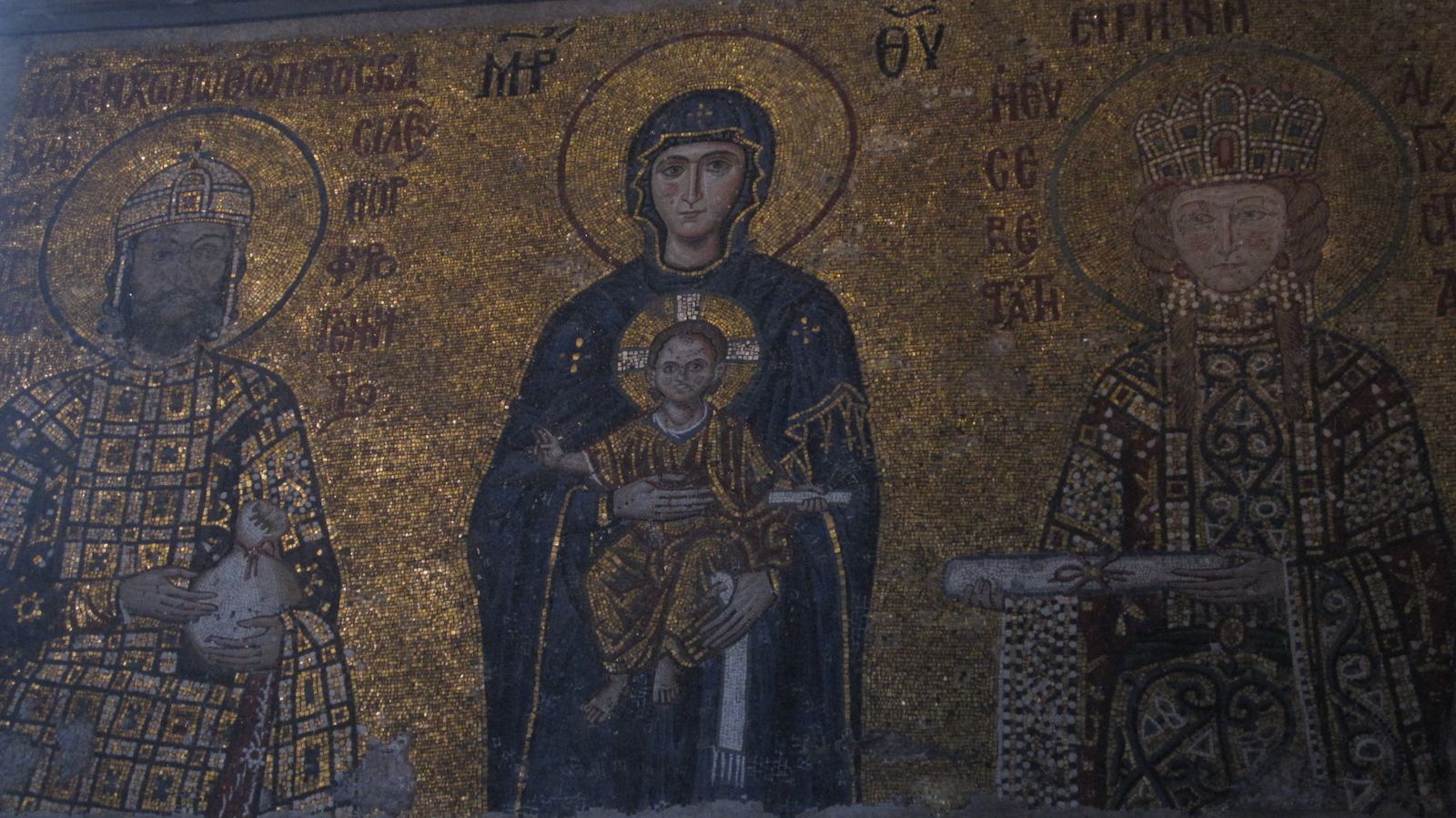 This is my favorite building in the world and I think that a lot of other people must have shared my opinion for the place to have lasted this long through the centuries and many wars.
 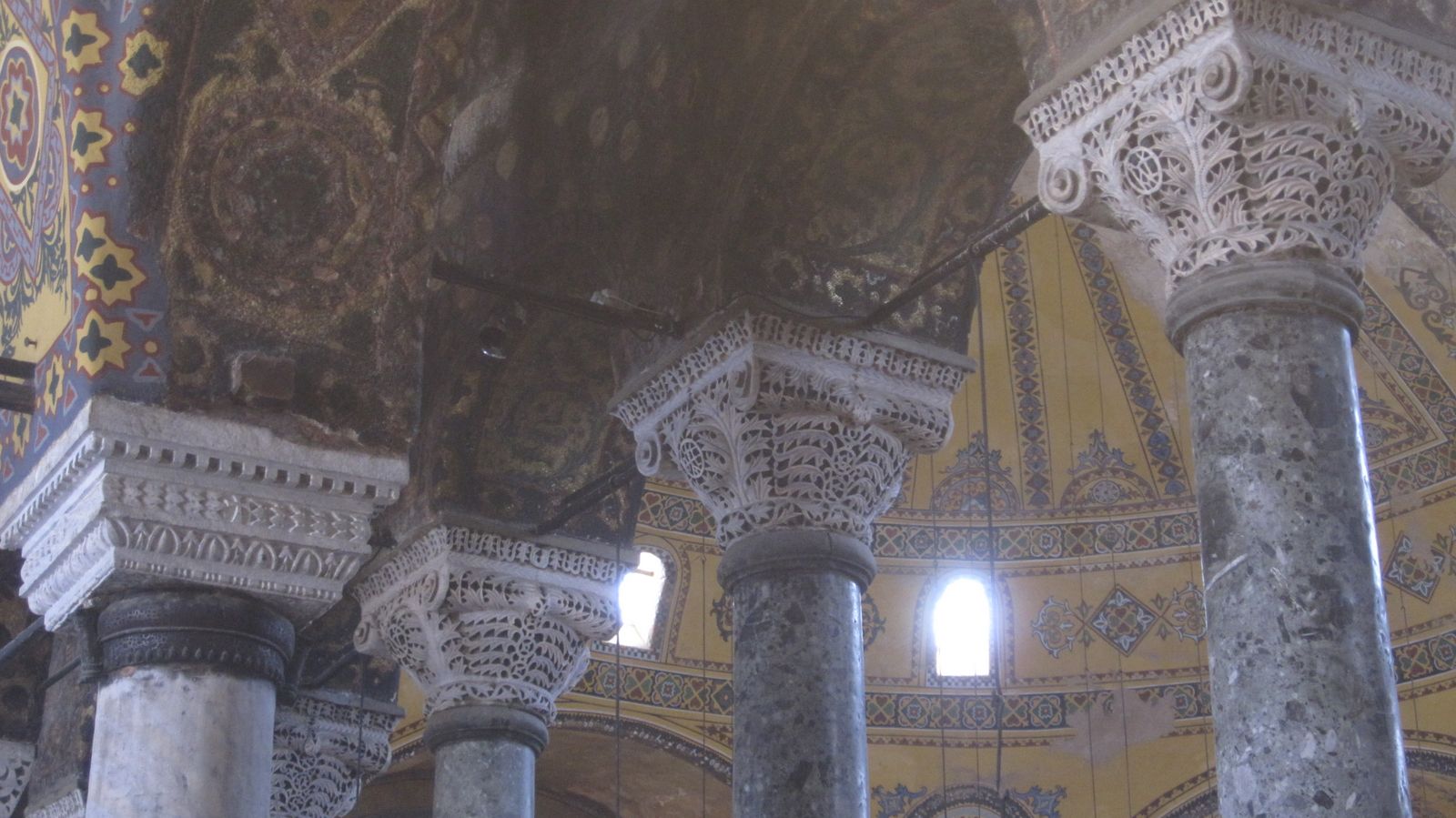 Of course when the Ottomans conquered the city in 1453 they converted the building to a mosque, but that involved only the simplest of modifications... mostly they painted over the mosaics and added a stone to indicate the direction of Mecca. Sam loved it too.
 After that we headed over to the grand bazaar to do a little shopping. It's a huge labyrinth of covered alleyways lined with shops that's very old and very famous. Of course huge numbers of tourists go there and a lot of the shops are focused just on that market, but many real business is done there too and it's an important part of Istanbul culture.
  It was also a good chance for me to show off all that I've learned in the arts of haggling and I helped her get a bracelet, a few souvenirs for friends, and we got a knockoff purse too. We must have visited a dozen shops to buy each one of those items, but that's an important part of the haggling process. Also helpful is my ability to count and ask for student discounts in Turkish.
 By then it was getting pretty warm so we hit the Basilica Cistern next. It was one of the highlights the last time we visited and it did not disappoint this time either. It's an old underground water storage depot, built by the Romans, and then forgotten for 1500 years. In modern times it was rediscovered by a German scientist investigating rumors of holes in people's basement that produced fresh water if a bucket was lowered.
  Some people reported catching fish in the buckets as well. The scientist found an entrance to the cistern and now it's a great place to enjoy the cool and creepy atmospheric lighting on a warm summer day. There are of course monstrously fat carp swimming around the pools and several of the supporting columns were recycled from previous temples and have some character to them. A couple of them have Medusa heads but they don't seem to bother the fish.
 For dinner we went to the bridge crossing the Golden Horn, a famous stretch of water, and underneath are dozens of fish restaurants with live music. We chose one of them and had a pretty good, though pricey, dinner with several fishy appetizers and a Black Scorpion fish as the main course. There was live music too of course, and a lot of the Turkish guests got up and did group line dances until we were so sick of the noise that we left.
 On our last full day in Istanbul we did the last great tourist attraction of great importance, Topkapi Palace. It was the home of the Sultans for the last 500 years and was a bit of a city unto itself. It housed hundreds of servants, craftsmen, guards, and had huge workshops for making jewelry, food, weapons, and any special orders for the Sultan. The Sultan had many advisers who held countless meetings to resolve state issues and the Sultan would occasionally listen in on the meetings through a brass grate and couple call for private audiences with his advisers to give direct orders.
  This was partially to preserve the imperial mystique but also because in subsequent generations the princes would seldom receive a real education and were largely unable to govern effectively. This is because the many concubines of the Sultan would murder each others children to advance their own, and so mothers would often just lock the princes in their rooms and not allow visitors.
 Sam got to visit the harem of the Sultan, which I did not because I didn't want to pay for the ticket. I saw it the last time I was in town. The women of the harem would be educated in history, politics, music, and other arts in order to better entertain the Sultan. They also served as important but unofficial advisers and some of the listened in on state business and would tell the Sultan what to do since they were a bright and educated bunch on their own.
 That all took a lot of time, and so we wanted to finish up the day in the Taksim neighborhood. Sam said that it reminded her of SoHo which is the highest compliment that she can give a place. We got dinner at one of those cafeteria style restaurants (Lokantasis) and then walked around with some beers. There was a free concert being put on in the neighborhood and we listened in on some of that before heading home.
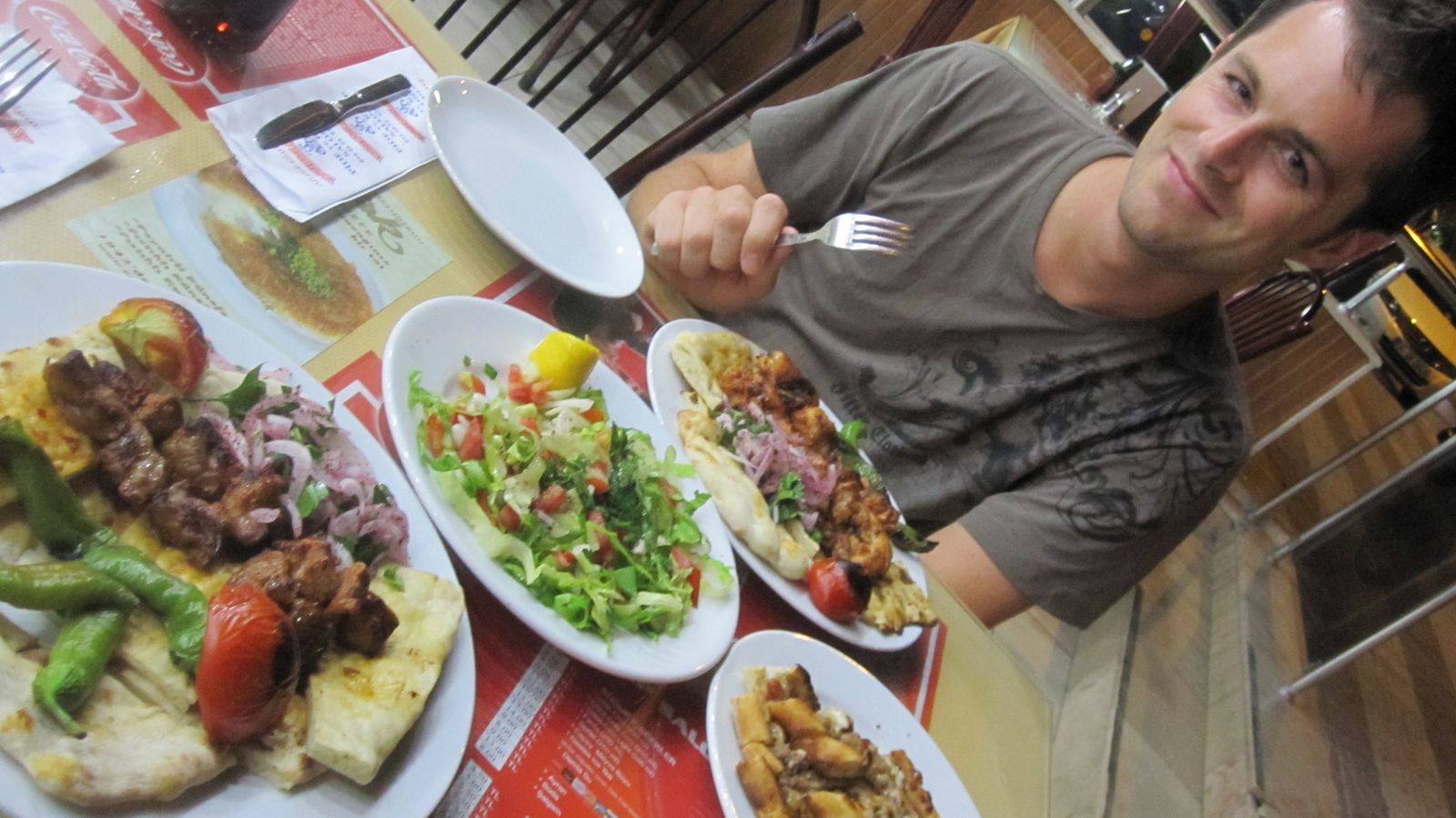 We had to get up really early to catch the ferry out of town. I heard about a shortcut when going from Istanbul to Kusadesi where you take a ferry to Bursa and then a bus from there. Without the shortcut, it's a 9 hour bus ride. With the ferry in between, it was still a good 9 or 10 hours of travel time, but at least it had some variety. We got in and checked into a hotel with a pretty fair price of $25 a night for a huge room with a balcony and private bath. Later that night we went out for kebabs but had to hike into town pretty far to find a restaurant that was serving mostly Turkish people. Those ones have the best kebabs.
 Kusadesi is a serious tourist town and when we got in there was a cruise ship docked at the port, 100 yards from downtown. The waterfront is totally covered with shops selling knockoffs purses, leather coats, shoes, jewelry, and tacky tourist junk. Most of the restaurants specialize in fish and chips (for the British cruisers) and bastardized Turkish cuisine. It's also twice the price of the stuff the locals eat so I won't do it. I'd rather go to a local place and order way too much... that's more satisfying for me.
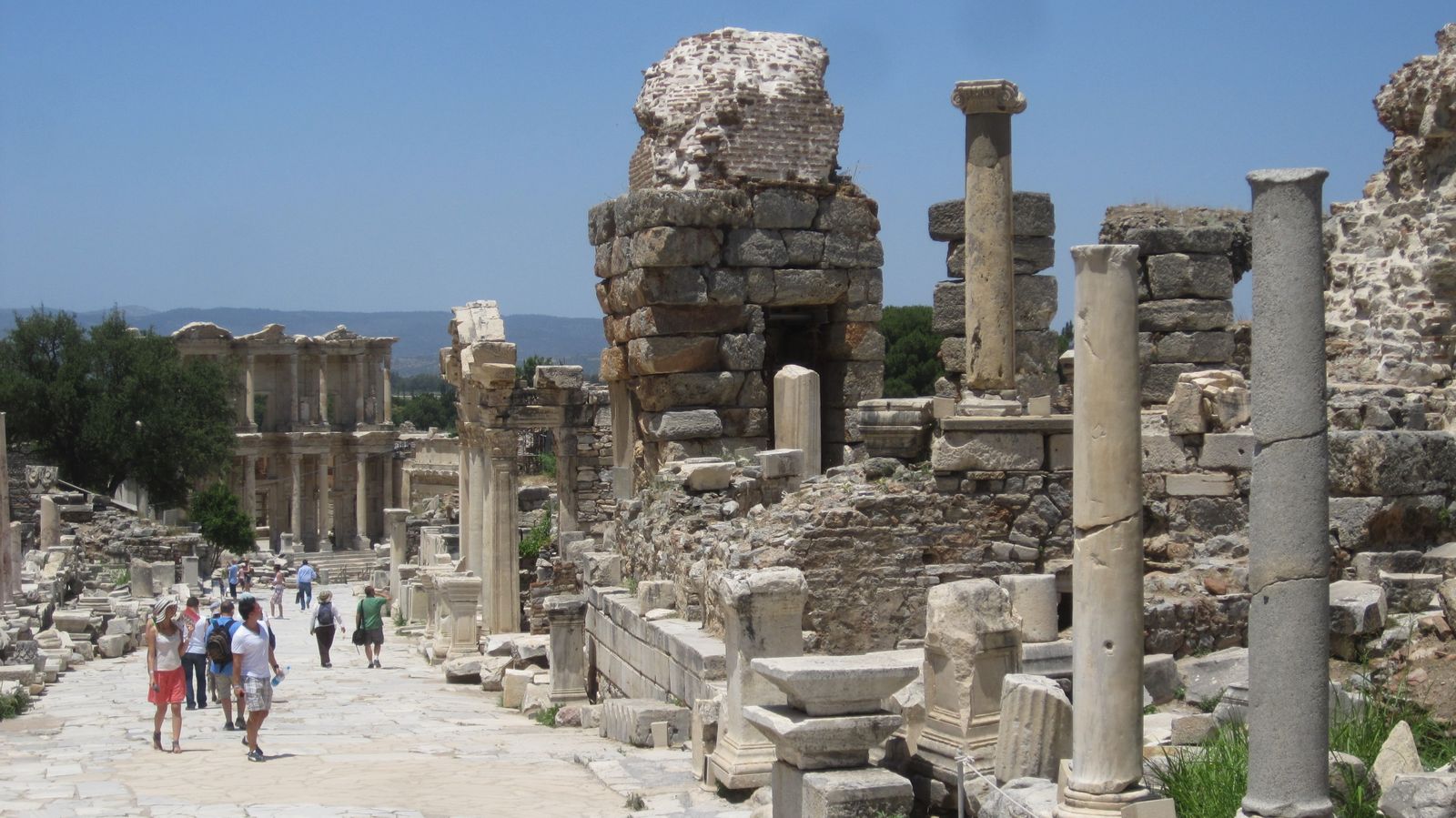 The next morning we got up early to go to Ephesus. We took a bus to the ottogar and then another to get to the ancient site. Ephesus was a rich Greek city in it's day and when the Romans took it over it flourished for a couple hundred more years. The problem was, the harbor got silted up and turned into a malaria riddled swamp. That had a negative effect on the local populous and the city was abandoned. It has since been rebuilt in modern times to some degree... they put up a few of the buildings that had fallen over and it's actually one of the nicest Greek sites in Asia.
 The first thing to see there is the huge theater. I wonder if St Paul preached at this very theater? Anyways, he wrote the letters to the Ephesians while he was imprisoned in Rome around 62 AD. Ephesus was a very important center of early Christianity. Nearby the city is a shrine that Mary supposedly spent her last years at.
 We also got to see the famous library of Ephesus. It's a two story building and was built by one of the rulers in honor of his father who must have loved scholarly pursuits. I donb't have much to say about it but it was a lovely old building. Oh, I heard that some archeologists believe that there's a tunnel connecting it to the brothel across the street. I've also heard that it's BS. You decide.
 Other sites include the public toilets, a large room with about 30 toilet holes in a stone bench that had running water underneath. They also had shared sea sponges for washing up. We also walked along several column lined streets trying to find as much shade as possible since it was extremely hot and all the water we had didn't seem to make much of a difference.
  We nearly got heat stroke but eventually we finished up the tour. While waiting for the bus back to town I picked mulberries from the nearby trees. They look like white blackberries and taste very sweet.
Later in the afternoon we hit the hamam, or Turkish bath. It's a very traditional thing in all of the middle east, and it's something that they learned from the Romans who were quite fond of it too. Basically you strip down, wrap in a towel, and sit in a sauna for a good long time. 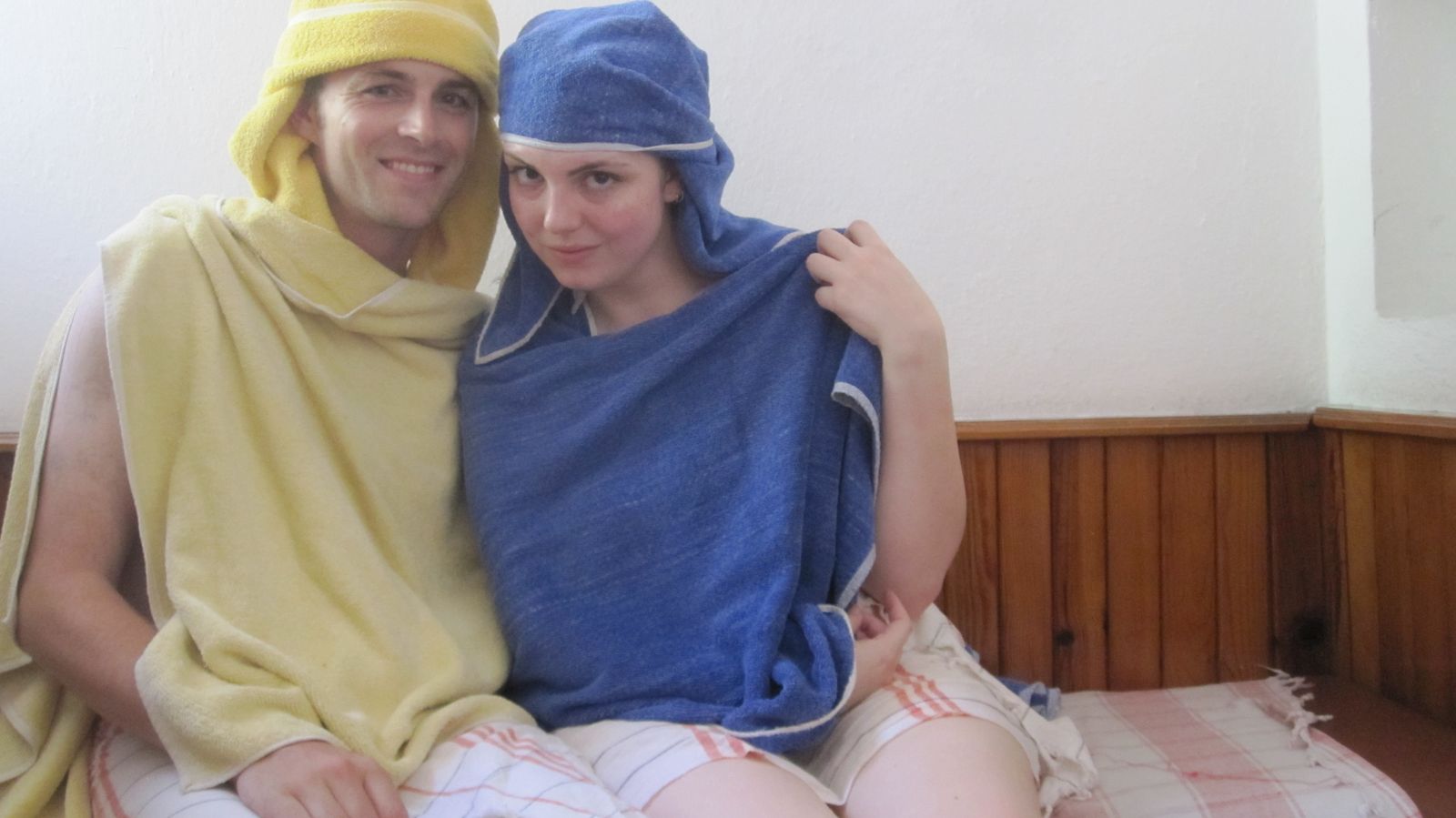 Then, a hairy Turkish guy washes your hair and then scrubs down your whole body with an abrasive pad to exfoliate the skin. After a rinse, he then soaps you up with a huge sponge and then gives a quick massage. Finally, you wash off again and then dry off in the 'cold room' where they bring you an apple tea. Good times, but Sam didn't care for the hairy Turkish guy exfoliating her. This is an unusual hamam for being co-ed. That night we also had a group dinner at the hotel with a bunch of Aussies but it wasn't particularly good.
Then, a hairy Turkish guy washes your hair and then scrubs down your whole body with an abrasive pad to exfoliate the skin. After a rinse, he then soaps you up with a huge sponge and then gives a quick massage. Finally, you wash off again and then dry off in the 'cold room' where they bring you an apple tea. Good times, but Sam didn't care for the hairy Turkish guy exfoliating her. This is an unusual hamam for being co-ed. That night we also had a group dinner at the hotel with a bunch of Aussies but it wasn't particularly good.The next morning we sailed for the Greek island of Samos, but I'm going to end this here. Sam said that she might like to write a guest post, so I'll let her cover the Greek islands... a rich source of narration.